|
Case Report
Ileo-ileal knotting: An unusual cause of acute strangulated intestinal obstruction
1 Fellow West African College of Surgeons, FWACS (Consultant Surgeon), Department of Surgery, Alex-Ekwueme Federal University Teaching Hospital, Abakaliki, Ebonyi State, Nigeria
2 Fellow West African College of Surgeons, FWACS, FCIS, MPH, Consultant General Surgeon, Department of Surgery, Alex-Ekwueme Federal University Teaching Hospital, Abakaliki, Ebonyi State, Nigeria
3 Member West African College of Surgeons, MWACS, Senior Registrar, Department of Surgery, Alex-Ekwueme Federal University Teaching Hospital, Abakaliki, Ebonyi State, Nigeria
Address correspondence to:
Onyeyirichi Otuu
General Surgery Unit, Department of Surgery, Alex-Ekwueme Federal Teaching Hospital, Abakaliki, Ebonyi State,
Nigeria
Message to Corresponding Author
Article ID: 100088Z12OO2021
Access full text article on other devices

Access PDF of article on other devices


How to cite this article
Otuu O, Eni EU, Oguonu AC. Ileo-ileal knotting: An unusual cause of acute strangulated intestinal obstruction. J Case Rep Images Surg 2021;7:100088Z12OO2021.ABSTRACT
Introduction: Intestinal knotting is the obstruction of an intestinal segment with closed loop phenomenon secondary to knotting of the mesentery. Ileo-ileal knotting remains the rarest of all intestinal knotting.
Case Report: A 35-year-old female patient presented to the emergency department with colicky abdominal pain of 5 days duration with associated bilious vomiting, progressive abdominal distention, and constipation. She had four previous caesarean sections. The abdomen was grossly distended with generalized tenderness, guarding, and absent bowel sounds. Plain abdominal roentgenogram showed dilated loops of small bowel with multiple air-fluid levels and absent rectal gas shadow. A diagnosis of complicated adhesive intestinal obstruction was made and patient underwent emergency exploratory laparotomy. The proximal loop of ileum was found to be knotted on the distal ileum with the entrapped loop being gangrenous. She had resection of the gangrenous gut with end-to-end ileal anastomosis and made an uneventful recovery.
Conclusion: A high index of suspicion and immediate surgical intervention is needed in the management of this entity because it can progress rapidly to strangulation.
Keywords: Ileo-ileal knotting, Intestinal knotting, Intestinal obstruction
Introduction
Small intestinal obstruction is a surgical emergency that could result from hernias, adhesions, bands, primary volvulus, and intussusceptions. Unusual causes like Intestinal knotting have been documented [1]. Intestinal knotting is the obstruction of an intestinal segment with closed loop phenomenon secondary to knotting of the mesentery [2]. Reports abound of different types of intestinal knotting like appendico-ileal, ileocecal, ceco-sigmoid, ileo-sigmoid, but ileo-ileal remains the rarest of them all [2],[3],[4],[5]. We present a rare case of an acute strangulated intestinal obstruction caused by an ileo-ileal knot in a 35-year-old female patient who had four previous caesarean sections.
Case Report
A 35-year-old female patient presented to the emergency department with colicky abdominal pain of five days duration with associated bilious vomiting, progressive abdominal distention, and constipation. The patient had four previous caesarean sections and the last surgery was four months before presentation.
Upon examination, she was in intermittent painful distress. Her vital signs were pulse rate of 110 beats per minute, blood pressure of 100/70 mmHg, respiratory rate of 32/min, and temperature of 36.5°C. Her tongue and buccal mucosa were dry. The abdomen was grossly distended with generalized tenderness and guarding. The bowel sounds were absent. Digital rectal examination revealed an empty rectum. Her hematological parameters were within normal range. Plain abdominal roentgenogram showed dilated loops of small bowel with multiple air-fluid levels and absent rectal gas shadow. The patient was resuscitated and a provisional diagnosis of complicated adhesive intestinal obstruction made.
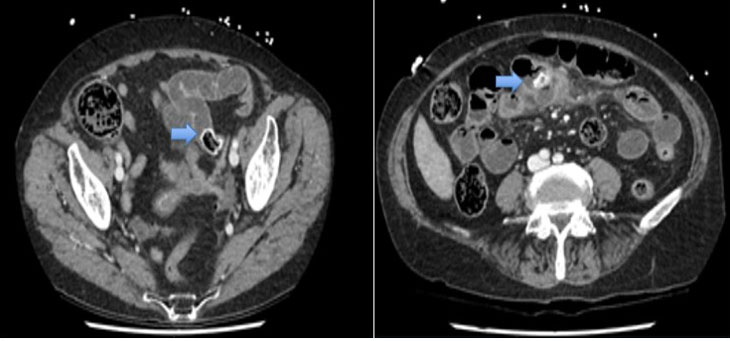
The patient was prepared and urgent exploratory laparotomy done through midline incision. About 1000 mL of dark hemorrhagic fluid was encountered in the peritoneal cavity which was suctioned out. The proximal loop of ileum was knotting on the distal ileum (Figure 1). The entrapped gangrenous loop of ileum measured 50 cm and was 60 cm from the ileocecal valve (Figure 2).
En bloc resection and ileo-ileal end-to-end anastomosis was done to re-establish the continuity of the gut. The remaining small bowel was approximately 220 cm. The patient developed superficial surgical site wound infection which was successfully treated with dressing and antibiotics. She was discharged after two weeks of hospital stay. She has continued to be in good health after six months of follow-up.


Discussion
First description of intestinal knotting was by Riverius in the 16th century and later by Rokitansky in 1836 [2]. The commonest type of intestinal knot syndrome is the ileo-sigmoid knot while the ileo-ileal knot remains very rare entity [3],[6]. In a study by Shepherd, out of 92 cases of intestinal knot, only one case of an Ileo-ileal knot was found [3]. In the same study, sigmoid volvulus was seen in males five times as often as intestinal knotting, whereas in females intestinal knotting was seen nearly twice as often as sigmoid volvulus [3].
Ileo-ileal knotting is a type of closed loop obstruction where one part of the ileum remains static and the other part wound around the static part. Once a knot is formed, it sets off vicious cycle of intestinal occlusion, and continuous peristalsis and vascular compromise all lead toward gangrene [3],[7],[8],[9].
The etiology of intestinal knotting including ileo-ileal knotting is unknown. However, the condition is most common in areas where small intestinal and sigmoid volvulus is common and may be related to high fiber bulky diets and excessive motility of the ileum [4],[7],[10],[11]. The mortality rate is about 50% [3],[7],[9].
Ileo-ileal knotting presents like most small bowel obstruction with no particular or classical signs and symptoms to it except a rapid deterioration and progression to gangrene [4],[12]. Like in our index case, patients have been known to present with the typical features of intestinal obstruction with adhesion as a possible etiology, but on laparotomy ileo-ileal knotting was discovered to be the cause [8]. The preoperative diagnosis of these conditions is very difficult or impossible. In most cases, the diagnosis is established intraoperatively, as in the present case [2],[5]. Early intervention is needed, and the most effective diagnosis and treatment for this unusual condition is surgery after adequate resuscitation with intravenous (IV) fluid, abdominal decompression with nasogastric tube, and broad spectrum IV antibiotic [4],[5],[9]. Emergency laparotomy should be performed through midline incision, and the abdominal cavity should be carefully explored [4],[7]. The operative procedure of choice is to carefully unravel the knot if both loops are found viable; or to perform an en bloc resection of the gangrenous segments if these are followed by primary anastomosis [2],[3],[4],[8].
Postoperatively, the patient should be monitored for hydration status, anemia, and signs of anastomotic leak. Follow-up for signs of short bowel syndrome should be instituted depending on the length of resected gut and symptoms exhibited by the patients [4].
Conclusion
A high index of suspicion and immediate surgical intervention is needed in the management of this unusual entity called ileo-ileal intestinal knotting because it can progress rapidly to strangulation.
REFERENCES
1.
Tsegaye S, Osman M, Bekele A. Surgically treated acute abdomen at Gondar University Hospital, Ethiopia. East Cent Afr J Surg 2006;12:53–7.

2.
Andromanakos N, Filippou D, Pinis S, Kostakis A. An unusual synchronous ileosigmoid and ileoileal knotting: A case report. J Med Case Rep 2014;8:200. [CrossRef]
[Pubmed]
3.
Shepherd JJ. Ninety-two cases of ileosigmoid knotting in Uganda. Br J Surg 1967;54(6):561–6. [CrossRef]
[Pubmed]
4.
Abebe E, Asmare B, Addise A. Ileo-ileal knotting as an uncommon cause of acute intestinal obstruction. J Surg Case Rep 2015;2015(8):rjv102. [CrossRef]
[Pubmed]
5.
Taniguchi K, Iida R, Watanabe T, et al. Ileo-ileal knot: A rare case of acute strangulated intestinal obstruction. Nagoya J Med Sci 2017;79(1):109–13. [CrossRef]
[Pubmed]
6.
Machado NO. Ileosigmoid knot: A case report and literature review of 280 cases. Ann Saudi Med 2009; 29(5):402–6. [CrossRef]
[Pubmed]
7.
Cowley DJ, Iweze F, Spencer J. Knotting of the small intestine. Proc R Soc Med 1971;64:54–5.
[Pubmed]
8.
Kumar SS, Grace RD, Lavanya, Abbinaya. A rare cause of intestinal obstruction - Ileoileal knotting. IOSR Journal of Dental and Medical Sciences (IOSR-JDMS) 2015;14:23–4.
9.
Krishna P, Kishore A, Prasad N, Humnakar A. Rare case of acute strangulated intestinal obstruction – Ileo-ileal knotting. Int J Surg Sci 2019;3(1):24–5.
10.
Socea B, Smaranda CA, Nica AA, et al. Rare small bowel obstruction due to phytobezoar – Case presentation. Arch Balk Med Union 2017;52(4):458–61.
11.
Socea B, Nica AA, Bratu OG, et al. Incidental finding of a sigmoid intussusception associated with rectal prolapse – A case report. Archives of the Balkan Medical Union 2018;53(1):143–6.
12.
Saraswathi S, Adaikkapan M, Sivakolunt M, Sethurajan S, Rajadirajan S, Vinoth T. A rare case of ileo-ileal knot – First ever case report in Indian radiology literature. Int J Modn Res Revs 2016;11(4):1365–7.
SUPPORTING INFORMATION
Author Contributions
Onyeyirichi Otuu - Conception of the work, Design of the work, Drafting the work, Revising the work critically for important intellectual content, Final approval of the version to be published, Agree to be accountable for all aspects of the work in ensuring that questions related to the accuracy or integrity of any part of the work are appropriately investigated and resolved.
Uche Emmanuel Eni - Conception of the work, Design of the work, Drafting the work, Revising the work critically for important intellectual content, Final approval of the version to be published, Agree to be accountable for all aspects of the work in ensuring that questions related to the accuracy or integrity of any part of the work are appropriately investigated and resolved.
Amobi Chiedozie Oguonu - Conception of the work, Design of the work, Drafting the work, Revising the work critically for important intellectual content, Final approval of the version to be published, Agree to be accountable for all aspects of the work in ensuring that questions related to the accuracy or integrity of any part of the work are appropriately investigated and resolved.
Guarantor of SubmissionThe corresponding author is the guarantor of submission.
Source of SupportNone
Consent StatementWritten informed consent was obtained from the patient for publication of this article.
Data AvailabilityAll relevant data are within the paper and its Supporting Information files.
Conflict of InterestAuthors declare no conflict of interest.
Copyright© 2021 Onyeyirichi Otuu et al. This article is distributed under the terms of Creative Commons Attribution License which permits unrestricted use, distribution and reproduction in any medium provided the original author(s) and original publisher are properly credited. Please see the copyright policy on the journal website for more information.